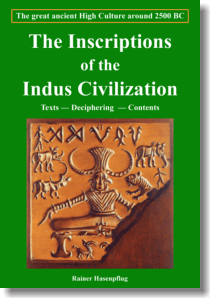
Our Goal:
Nobel Prize for India
The book can be ordered worldwide in a good book-shop giving the ISBN 3-8334-4613-7, published by Books on Demand, Norderstedt, Germany, 2006.
Or to order at Amazon:
USA
Germany

United Kingdom

France

Canada

Japan
Interested Indian publishers are welcome!
Everyone feel free to contact us:
mail@indus-civilization.info
Masthead:
Dipl.-Ing.
Rainer Hasenpflug,
Budapest,
Hungary
...NOW
YOU
KNOW!
The Indus Civilization - existing from about 3000 until 1700 BC in today's India and Pakistan - has been the largest known empire of early ancient times. It has been not only larger than those times Sumeria, Egypt, China etc., with what it has been in more or less intensive economic and cultural contact, it also has been standing on the top of the development of the world's culture and civilization. The Indus Civilization created the most advanced cities of those times, build on huge artifical platforms with fortifications made from millions of standardized high quality bricks, and equipped with far developed hygienic water systems, following 'perfect' building plans. The arts, trade, crafts, and agriculture were highly developed. Since the excavations we know the Indus pictures and signs show the great Indian mythology and the human remainings show their Indo-Iranian ancestry. This was then confirmed by newer genetic examinations. This facts were certainly always hard to imagine without using the language of Sanskrit. But the Indus Civilization was still less known because of the illegibility of its sophisticate hieroglyphic inscriptions and thus the lack of extensive information.
Sanskrit Texts from the late Rigveda Age with amazing extensive Information!On the basis of the so called 'pictorial bilinguals' - texts escorted by content related beautiful Indian mythologic pictures - we could then decipher all of the more than 2000 known texts. We discovered that the script is constructed by syllabics and pictograms, the same like the until today scripts used in East Asia. The used language is indeed as expected the well known holy ancient Indo-Iranian language of Vedic Sanskrit. The texts give innumerable information on the world view of the Indus empire's citizens, on the social life, religion, international conflicts, warfare, economy, linguistics etc. In all details the content matches with the information we have from the famous Rigveda! This proves finally, that the Vedic culture, and with this the great Indian civilization, has its glorious origin not, as the colonial narrative says, in the later steppe invasion nor in the southern Dravida culture, but much further back in the indigenous Indo-Iranian neolithic period. Our work is, since it was published more then twenty years ago, uncontested!
More than 5000 Years of cultural Continuity!The Indus inscriptions are an invalueable treasure of information on the original Indo-Iranian and world civilization. Experts of many fields, lovers of the concerned nations, of history and culture will find here an exciting reading matter. The people of today India and Pakistan can be proud on their cultural heritage! In fact the Indus Civilization has never disappeared, but it was setting the great starting point for their civilizations as has been existing until today. Especially the great Indian civilization is in straight line the descendand of the Indus Civilization and its achievements. A huge part of today's Indian culture and identity has its glorious origin in the Indus Civilization: languages, mythology, religion, social and cultural life, crafts, traditions etc. The time of questioning, disregarding Indias glorious history and rich mythology should be over now! It is easy now to read for everyone the around 4500 years old original texts from the beginnings of the great Indian and world civilization. To read this is a great experience for sure - not only, but especially, for everyone who likes India.
Further, the original Texts of the Indus Civilization give Answers as well about:- The Rigveda age as the founder, pre urban period of the IC
- A new view on the Neolithic, Mesolithic age in the entire Middle East, South Asia
- Why there was officially never an essential progress on this field of science
- Why Indian scientists, facts are largely ignored by the West
- The Western narrative as a 250yo disproved colonial theory
- The Western narrative as a postcolonial, anti Indian desinformation campaign
- The Western narrative as a strategy to destroy the cultural, national identity of India
- The Western plans for, activities in India

The book is laid out in a consequential, objective and non-selective, logical and scientific method, but with high-grade understandability. The fantastic utopias of some authors in the past are rejected here by the inscriptions themselves. But the reality is much more amazing.
The book is produced in high quality, size A4, 408 pages, paperback, and with many illustrations. Content: deciphering, deciphering manuscript with depicted original texts, analysis of the contents.
- Professor em. University of Helsinki, Finland
- Published several works on the Indus script
- Published the catalogue of Indus texts
- Studied several ancient and modern languages in several European and Asian countries
- Studied Avesta in Iran and Sanskrit in India for some years
- Worked as a linguist at the German ministry of defense for three decades
- Graduate engineer of architecture and town building
- Researched for some years at the 'German Research Project Mohenjo Daro' at the Technical University of Aachen on the Indus Civilization